
Conflict of Interest Policy
Canadians for a Civil Society (CCS)
Conflict of Interest Policy
1.0 Purpose
All CCS Directors have a duty to ensure that the integrity of the decision-making processes is maintained by ensuring that they and other Board members are free from conflict. It is inherent in a director’s fiduciary duty that conflicts of interest be avoided and all directors must understand their obligations when a conflict, or potential conflict, of interest arises.
2.0 Description
A conflict of interest arises in any situation where a director’s duty to act solely in the best interests of CCS is compromised by any other personal interest, relationship, or duty, such that the Director is not able to fully discharge the fiduciary duties owed to CCS.
Situations in which potential conflicts of interest may arise cannot be exhaustively set out, although conflicts generally arise in the following situations:
1. Transacting with CCS
When a director has a direct or indirect, interest in a transaction with CCS.
2. Interest of a Relative
When CCS conducts business with suppliers of goods or services of which a relative or member of the household of a director is a principal, officer or representative.
3. Accepting Gifts
When a director accepts gifts, payments, or services of more than a nominal or token value from a party with whom CCS may transact business or for the purposes of influencing a decision of the CCS Board.
4. Acting for an Improper Purpose
When a director exercises his or her powers motivated by self-interest or other improper purpose or diverts an opportunity or advantage that belongs to CCS to his or her own use.
5. Accepting a Fulltime or Part-time Contract Position
When a director agrees to accept a CCS fulltime or part-time contract position he or she is required to resign immediately from the CCS Board. The former Board member shall not be able to reapply to join the Board for 12 months after the completion of the contract position.
3.0 Disclosure of a Conflict, or a Potential Conflict, of Interest
- A director who believes he or she may have a conflict of interest shall immediately disclose such conflict to the Board by notification in writing to the President. Where the President has a conflict, notification shall be given to the Vice-President. The disclosure shall be sufficient to detail the nature and extent of the potential conflict of interest.
- The director who has declared a conflict shall not be present during the discussion or vote in respect of the matter in which the director has a conflict and shall not attempt to influence the voting.
- A second source for referral of a conflict of interest is from a director who believes that another director has breached the director’s duties to CCS and that an actual or potential conflict of interest has occurred or may occur.
- The matter shall be immediately disclosed in writing to the President, or, where the issue may involve the President, to the Vice-President. The disclosure shall be sufficient to detail the nature and extent of the potential conflict of interest.
- The President (or Vice President as the case may be) may either attempt to resolve the matter informally or refer the matter to an ad hoc sub-committee of the Board established by the President (or Vice-President). If the second option is chosen the sub-committee shall report to the Board. A decision of the Board by a majority resolution shall be conclusive.
- It is recognized if a breach of duty has occurred, or if a conflict cannot be resolved to the satisfaction of the Board by majority resolution, the director involved may be asked to resign or may be subject to removal pursuant to the CCS bylaws.
4.0 Amendment
This policy may be amended by the CCS Board of Directors.
Approved by Board Directors (June 19, 2023)
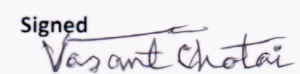
Vasant Chotai, CCS President, June 19, 2023